

Medically reviewed by Prof Fabio Castiglione, GMC 7542824 — last reviewed 17 August 2026
Chronic pelvic pain syndrome in men — more precisely chronic prostatitis/chronic pelvic pain syndrome, or CP/CPPS — is pelvic pain or discomfort lasting at least three months, usually accompanied by urinary or sexual symptoms, where investigation has excluded infection, cancer, obstruction and retention. It is the most common form of prostatitis seen in clinical practice, and it is a diagnosis of exclusion rather than a single disease.
That is the textbook definition. Here is what it looks like in the consulting room.
Most men who come to us with chronic pelvic pain have already been round the loop several times. Pain in the perineum, the tip of the penis, the testicles or the lower abdomen. A burning sensation when passing urine, or the constant sense of needing to go. Discomfort after ejaculation. Two or three courses of antibiotics that helped for a week and then did nothing. A urine culture that came back clean. And, eventually, the suggestion that it might be stress.
By that point, many men have started to wonder whether anyone believes them.
They should be believed. Chronic pelvic pain is a real physical condition with identifiable mechanisms, and it is treatable — but only when the treatment is matched to the mechanism that is actually driving the pain. That is the central point of this article.
How common is chronic pelvic pain in men?
Prostatitis in its various forms affects approximately 9.3% of men at some point in their lifetime, and chronic pelvic pain accounts for the large majority of those presentations (JAMA, 2025). It is not a rare condition, and it is not a diagnosis of last resort. It is simply one that is frequently missed, because it does not behave like an infection and it does not show up on the tests most men are given first.
What are the symptoms?
The pattern varies, which is part of why chronic pelvic pain in men is so often misidentified. The most common presentations include:
- Pain or aching in the perineum (between the scrotum and anus), lower abdomen, groin, testicles, penis or lower back, persisting for three months or longer
- Urinary symptoms — frequency, urgency, hesitancy, a weak or interrupted stream, or discomfort on passing urine
- Sexual symptoms — pain during or after ejaculation, reduced erectile function, or loss of desire secondary to the pain
- Symptom fluctuation — pain that eases when you are warm and relaxed and worsens with stress, prolonged sitting, cycling or cold
- Impact on mood and sleep, which is a consequence of persistent pain rather than its cause
That last point matters. The condition is associated with emotional disturbance and reduced quality of life, and this is a normal response to living with unexplained pain — not evidence that the pain is psychological in origin.
What causes chronic pelvic pain in men?
Current understanding, reflected in both European Association of Urology guidance and the 2025 American Urological Association guideline, is that chronic pelvic pain in men arises from a complex interaction of inflammatory, infectious, neurological, musculoskeletal and psychosomatic factors rather than from a single cause (Deutsches Ärzteblatt International, 2023).
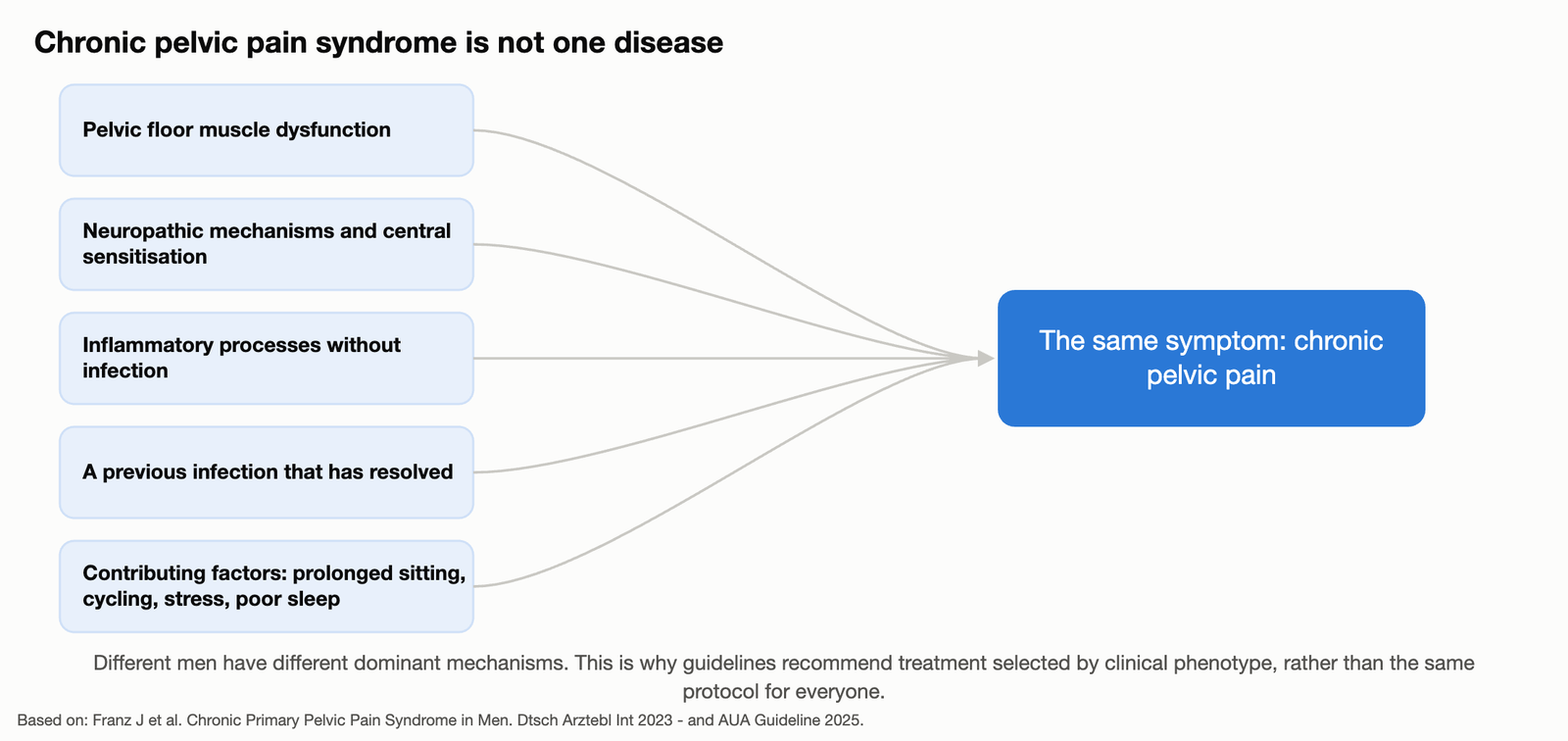
In practical terms, the pain in any individual man may be driven predominantly by:
- Pelvic floor muscle dysfunction — muscles that have become chronically overactive and tender, generating pain and referred symptoms
- Neuropathic mechanisms — pain arising from altered nerve signalling and central sensitisation, where the nervous system continues to generate pain after any original trigger has resolved
- Inflammatory processes within the prostate or surrounding tissue, without demonstrable infection
- A previous infection that has resolved but left a persistent pain pattern behind
- Contributing factors including prolonged sitting, cycling, stress and sleep disruption
Different men have different dominant mechanisms. This is why a treatment that transforms one patient’s symptoms does nothing for another, and why the current guidelines recommend selecting treatment according to clinical phenotype rather than applying the same protocol to everyone.
Why antibiotics usually do not work
Because the formal name for chronic pelvic pain in men contains the word “prostatitis”, the reflex response is an antibiotic. For acute bacterial prostatitis and chronic bacterial prostatitis that reflex is correct and effective. For chronic pelvic pain it is not, for a straightforward reason: there is no bacterial infection to treat.
The distinction is worth being precise about, because it determines everything that follows:
| Condition | Bacteria present | First-line treatment |
|---|---|---|
| Acute bacterial prostatitis | Yes — usually gram-negative | Broad-spectrum antibiotics, 2–4 weeks |
| Chronic bacterial prostatitis | Yes — recurrent, same strain | Minimum 4 weeks levofloxacin or ciprofloxacin |
| CP/CPPS | No | Phenotype-directed, multimodal |
If you have had repeated courses of antibiotics with no lasting benefit and negative urine cultures, that is not treatment failure on your part. It is a sign that the diagnosis needs revisiting.
How is it diagnosed?
Chronic pelvic pain in men is diagnosed when a proper assessment finds no other explanation for the symptoms. That assessment should include a detailed history, physical examination including assessment of the pelvic floor, urine culture and post-void residual measurement, with further imaging or investigation where the history suggests it.
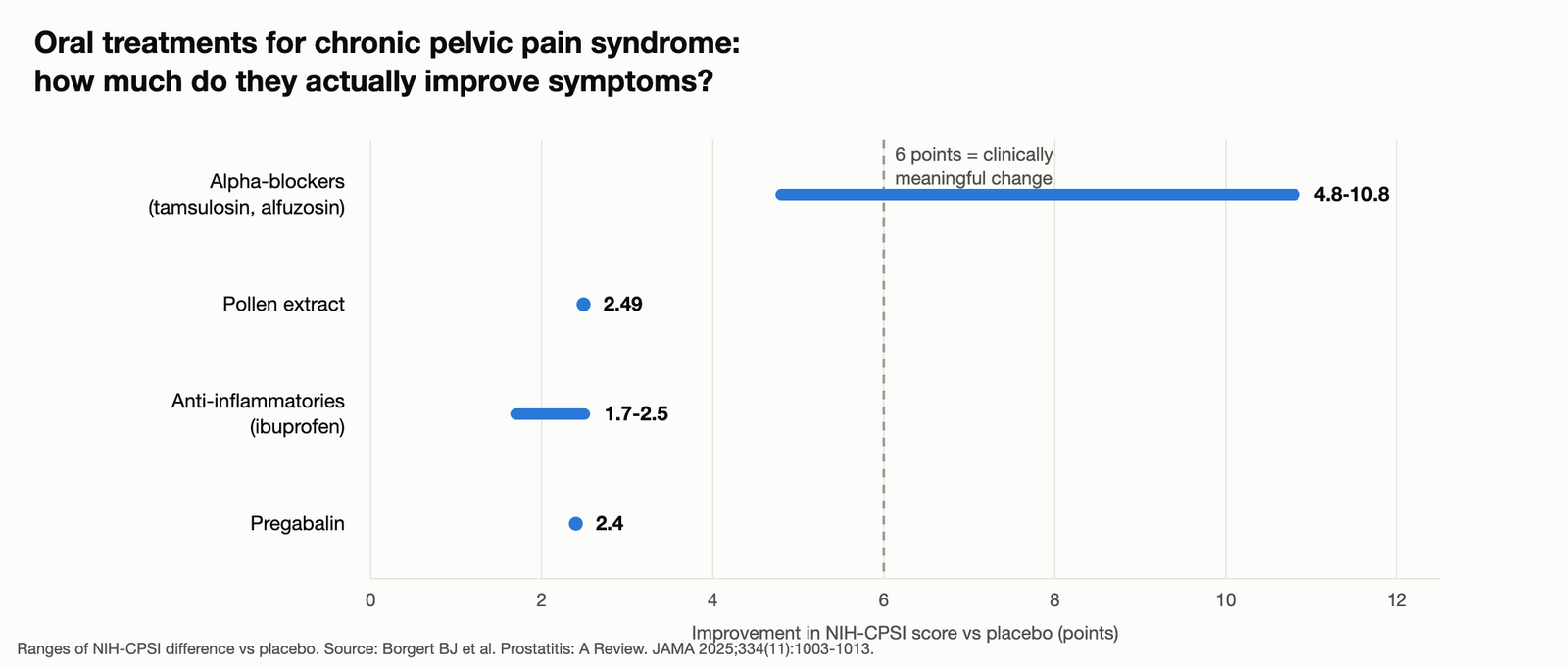
Symptom severity is measured using the NIH Chronic Prostatitis Symptom Index (NIH-CPSI), a validated questionnaire scored from 0 to 43. A change of 6 points is considered clinically meaningful. This matters for two reasons: it gives a baseline against which treatment can be judged objectively, and it prevents both patient and clinician from relying on impressions of whether things are “a bit better”.
What does the evidence say about treatment?
This is where honesty is more useful than enthusiasm. Some treatments for chronic pelvic pain have solid randomised evidence; others are widely offered on much thinner grounds. Here is where the current evidence stands.
α-blockers — the strongest oral evidence. For men whose presentation includes urinary symptoms, α-blockers such as tamsulosin and alfuzosin are first-line oral therapy, with a difference in NIH-CPSI score versus placebo of −10.8 to −4.8 (JAMA, 2025). Given that 6 points is the threshold for clinical meaningfulness, this is a genuine effect.
Other oral therapies — modest. Anti-inflammatories such as ibuprofen produce NIH-CPSI differences of −2.5 to −1.7 versus placebo; pregabalin −2.4; pollen extract −2.49 (JAMA, 2025). These are real but small effects, below or around the threshold of clinical meaningfulness. They have a place in a combined approach, but they are unlikely to resolve symptoms alone.
Shockwave therapy — good evidence for pain. A 2024 systematic review and meta-analysis of randomised trials found that men with chronic pelvic pain receiving extracorporeal shockwave therapy had more pronounced pain relief and greater improvement in NIH-CPSI scores than control groups receiving placebo or medication, with the effect still demonstrable at six months (Neurourology and Urodynamics, 2024). It is non-invasive and has a high safety profile. This is currently one of the better-supported interventions for the pain component of chronic pelvic pain.
Pelvic floor physiotherapy — supportive but lower-quality evidence. A systematic review of pelvic floor physical therapy for pelvic floor hypertonicity found benefit, with three of four randomised trials showing positive effects, and concluded that it appears efficacious in chronic prostatitis and CPPS — while noting that most studies carried a high risk of bias (Sexual Medicine Reviews, 2022).
Importantly, a separate meta-analysis of myofascial manual therapies specifically found them not significantly superior to standard care for pain reduction, with the quality of evidence graded “very low” (International Urogynecology Journal, 2022). The reasonable reading: assessment and treatment of the pelvic floor is worth doing where examination shows muscular overactivity, but it should be presented as a component of a plan, not as a proven cure.
A multimodal approach is what the guidelines actually recommend. The 2025 AUA guideline is explicit that effective treatment requires addressing symptoms and causes that fall outside the usual urological assessment, and recommends a multimodal, multidisciplinary approach including referral to other specialists and allied health professionals alongside management of urological symptoms (Journal of Urology, 2025). In practice this means a urologist, a pelvic floor physiotherapist and — where pain has become centrally driven — input from pain medicine or psychological therapy, working to one plan.
At our Male Pelvic Pain Clinic this is the model we follow: identify which mechanism dominates, treat that mechanism directly, measure the response with the NIH-CPSI, and adjust.
When should you see a specialist?
Arrange an assessment if:
- Pelvic, perineal, genital or lower abdominal pain has persisted for three months or more
- You have had one or more courses of antibiotics without lasting improvement
- Urine cultures have been negative but symptoms continue
- Pain is affecting sexual function, sleep, work or mood
- You have been told there is “nothing wrong” but the pain has not gone
Seek urgent medical attention rather than a routine appointment if you develop fever with pelvic pain, are unable to pass urine, or notice visible blood in your urine — these suggest a different and more acute problem.
Frequently asked questions
Is chronic pelvic pain syndrome the same as prostatitis?
It is one of the four recognised categories of prostatitis, and the most common. Unlike acute and chronic bacterial prostatitis, chronic pelvic pain syndrome involves no demonstrable infection, which is why it does not respond to antibiotics.
Will chronic pelvic pain go away on its own?
It can fluctuate, and some men improve spontaneously. But symptoms lasting more than three months warrant assessment, because the mechanisms that maintain the pain tend to become more established over time rather than less.
Does chronic pelvic pain affect fertility or cause cancer?
Chronic pelvic pain is not a cancer and does not cause cancer. It can affect ejaculation and sexual function, which may affect conception indirectly, and this should be assessed if you are trying to conceive. It does not damage the testicles.
Is the pain psychological?
No. Living with persistent pain commonly affects mood and sleep, and psychological approaches can help manage centrally driven pain — but that is a treatment pathway, not a statement that the pain is imagined.
How long does treatment take to work?
This depends on the dominant mechanism and the treatment chosen. Shockwave protocols typically run over several weekly sessions, with effects assessed at completion and again at follow-up. Progress is measured objectively using the NIH-CPSI rather than impression.
This article provides general information and does not replace individual medical assessment. If you have persistent pelvic pain, arrange an assessment with a urologist or andrologist.
References
- Borgert BJ, Wallen EM, Pham MN. Prostatitis: A Review. JAMA. 2025;334(11):1003–1013. doi:10.1001/jama.2025.11499
- Lai HH, Pontari MA, Argoff CE, et al. Male Chronic Pelvic Pain: AUA Guideline Part II. J Urol. 2025;214(2):127–137. doi:10.1097/JU.0000000000004565
- Franz J, Kieselbach K, Lahmann C, Gratzke C, Miernik A. Chronic Primary Pelvic Pain Syndrome in Men. Dtsch Arztebl Int. 2023;120(29–30):508–518. doi:10.3238/arztebl.m2023.0036
- Labetov I, Vaganova A, Kovalev G, Shkarupa D. Extracorporeal shockwave therapy in treatment of chronic prostatitis/chronic pelvic pain syndrome: systematic review and meta-analyses. Neurourol Urodyn. 2024;43(8):1924–1937. doi:10.1002/nau.25524
- van Reijn-Baggen DA, Han-Geurts IJM, Voorham-van der Zalm PJ, et al. Pelvic Floor Physical Therapy for Pelvic Floor Hypertonicity: A Systematic Review of Treatment Efficacy. Sex Med Rev. 2022;10(2):209–230. doi:10.1016/j.sxmr.2021.03.002
- Dal Farra F, Aquino A, Tarantino AG, Origo D. Effectiveness of Myofascial Manual Therapies in Chronic Pelvic Pain Syndrome: A Systematic Review and Meta-Analysis. Int Urogynecol J. 2022;33(11):2963–2976. doi:10.1007/s00192-022-05173-x
Literature retrieved via PubMed.
Prof Fabio Castiglione, MD, PhD, FECSM, FEBU, Urologist (ITA)
Consultant Urologist and Andrologist — King’s College Hospital NHS Foundation Trust
Hon. Reader, King’s College London (UK) — Academic Lead of Urology
GMC 7542824 · Director and Founder of Holistic Andrology
Prof Castiglione has published extensively in peer-reviewed journals on andrology and regenerative urology. Publications on PubMed · ORCID · Verify GMC registration