

Medically reviewed by Prof Fabio Castiglione, GMC 7542824 — last reviewed 17 August 2026
Erectile dysfunction is the persistent inability to achieve or maintain an erection sufficient for satisfactory sexual activity. The word that matters in that definition is persistent: an occasional difficulty is a normal part of male sexual life and is not a medical condition. When the problem is consistent over several months, it is, and it usually has an identifiable cause.
That is the clinical definition. What brings men to the clinic is usually something less tidy.
Most have waited a long time before asking. Many have already tried tablets bought online without an assessment, sometimes at doses they chose themselves. A good number have concluded privately that this is simply what getting older looks like, and that nothing can be done. Almost all of them are surprised to learn that erectile dysfunction is one of the most treatable conditions in andrology — and that the erection is often the least important thing it tells us.
This article covers what causes erectile dysfunction, how it is properly diagnosed, why it can matter for your general health, and what the evidence actually supports in treatment.
What causes erectile dysfunction?
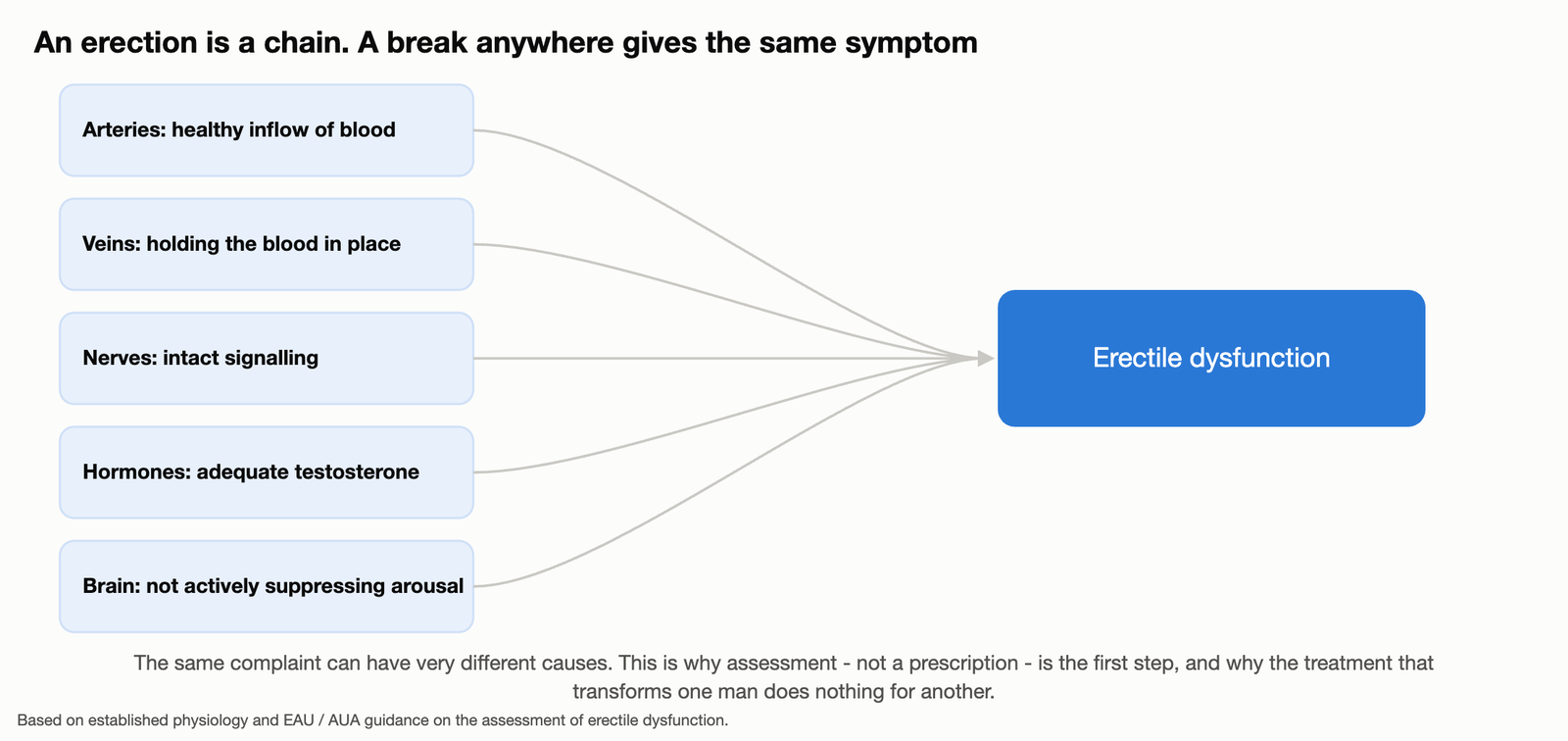
An erection is a vascular event coordinated by nerves and permitted by hormones. It requires healthy arteries to fill the penis, healthy veins to hold the blood, intact nerve signalling, adequate testosterone, and a brain that is not actively suppressing the process. A problem anywhere along that chain produces the same symptom, which is why the same complaint can have very different causes.
- Vascular causes — narrowed or stiffened arteries reduce blood inflow. This is the most common mechanism in men over 40 and links erectile dysfunction directly to cardiovascular health.
- Metabolic causes — diabetes is the single strongest medical association, damaging both small vessels and nerves.
- Neurological causes — spinal injury, multiple sclerosis, Parkinson’s disease, or nerve injury after pelvic surgery, particularly radical prostatectomy.
- Hormonal causes — low testosterone, thyroid disorders, or raised prolactin. These are less common than often assumed, but they are simple to test for.
- Medication — several widely prescribed drugs affect erectile function, including some antidepressants, antihypertensives and finasteride or dutasteride.
- Psychological factors — anxiety, depression, relationship difficulty and performance anxiety. These are genuine causes, not a diagnosis of exclusion, and they frequently coexist with physical ones.
How strong are these associations?
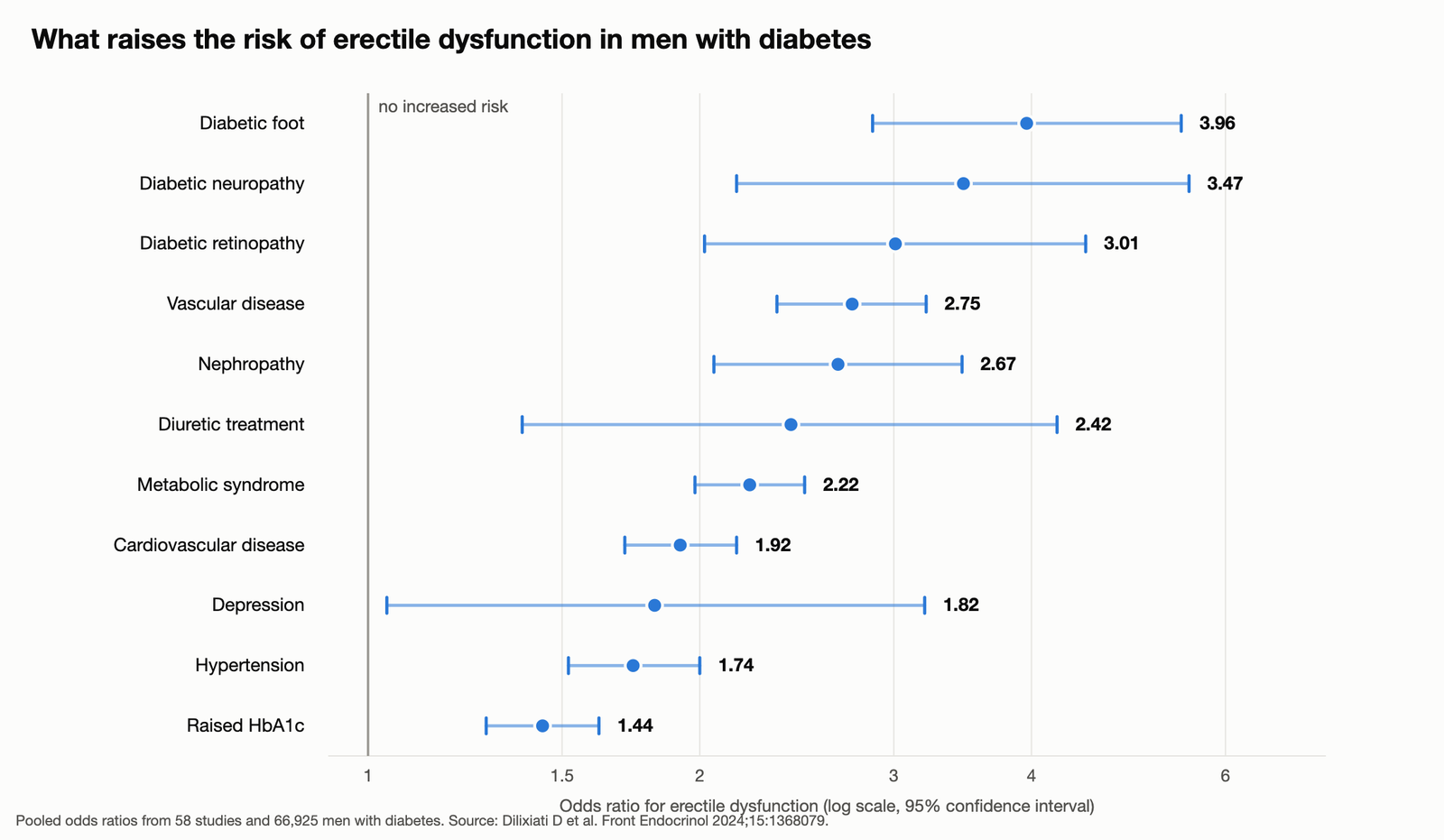
For diabetes the evidence is unusually clear. A 2024 systematic review and meta-analysis pooling 58 studies and 66,925 men with diabetes quantified which factors raise the risk of erectile dysfunction. Diabetic neuropathy roughly tripled the odds (OR 3.47), as did diabetic retinopathy (OR 3.01) and diabetic foot disease (OR 3.96). Vascular disease (OR 2.75), nephropathy (OR 2.67), metabolic syndrome (OR 2.22), cardiovascular disease (OR 1.92), hypertension (OR 1.74) and poorer glycaemic control as measured by HbA1c (OR 1.44) all independently increased risk (Frontiers in Endocrinology, 2024).
Read that list again and a pattern emerges: nearly every factor is a marker of blood vessel and nerve damage. Erectile dysfunction in a man with diabetes is rarely an isolated problem. It is usually a visible symptom of a systemic process.
Why erectile dysfunction matters beyond sex
The arteries supplying the penis are considerably narrower than the coronary arteries supplying the heart. When atherosclerosis develops throughout the body, the smaller vessels show it first. This is the reason erectile dysfunction is regarded in urology and cardiology alike as a potential early warning sign of cardiovascular disease rather than merely a sexual complaint.
The practical consequence is that a first presentation of erectile dysfunction is an opportunity. Blood pressure, lipids, glucose and weight should be checked — not as a formality, but because this is often the first time a man in his forties or fifties has had them measured at all.
There is also intriguing evidence about the treatments themselves. A large 2024 longitudinal study of 509,788 men with erectile dysfunction found that those prescribed tadalafil or sildenafil had significantly lower three-year rates of all-cause mortality (RR 0.66 and 0.76), myocardial infarction (0.73 and 0.83), stroke (0.66 and 0.78) and dementia (0.68 and 0.75) compared with men not taking them (The American Journal of Medicine, 2024).
This is observational data, and observational data cannot establish cause — men who are prescribed and take these drugs may differ in ways that were not fully adjusted for. It should not be read as a reason to take a tablet for your heart. But it is a useful counter to the idea that treating erectile dysfunction is a purely cosmetic exercise.
Erectile dysfunction in younger men
Erectile dysfunction is no longer a condition of older men alone. A 2024 review from a large paediatric and adolescent urology practice reported a thirty-one-fold increase in adolescent and young adult males presenting with erectile dysfunction since 2014, with the majority attributed to psychogenic causes such as anxiety and depression (Current Urology Reports, 2024).
Two things follow. First, a young man with erectile difficulty deserves a proper assessment rather than reassurance that he is too young for this. Second, in this group the answer is usually not a stronger tablet: it is addressing the anxiety, confirming that testosterone is normal, and often a period of low-dose daily treatment while confidence is rebuilt.
How is erectile dysfunction diagnosed?
A proper assessment is not complicated, but it should be thorough. It includes:
- A detailed history — how the problem began, whether it came on suddenly or gradually, whether morning erections are still present, whether it happens in every situation or only some. Sudden onset with preserved morning erections points towards a psychological component; gradual loss including morning erections points towards a vascular cause.
- The IIEF questionnaire — a validated score that establishes a baseline, so that improvement can later be measured objectively rather than by impression.
- Physical examination — including genital examination and assessment for signs of hormonal deficiency or Peyronie’s disease.
- Blood tests — fasting glucose or HbA1c, lipid profile, morning total testosterone, and further hormonal tests if that is abnormal.
- Penile Doppler ultrasound where a vascular cause is suspected or where treatment has failed — this measures arterial inflow and venous retention directly.
A man who has been given a prescription without any of the above has been treated, but not assessed.
What treatments are available, and what does the evidence support?
Treatment should follow the cause, and it should start with the least invasive option that is likely to work.
Addressing the underlying cause. Improving glycaemic control, treating hypertension, stopping smoking, losing weight and reviewing medications that may be contributing. This is unglamorous and it is where the largest long-term gains are.
PDE5 inhibitors — sildenafil, tadalafil and related drugs. These remain first-line for most men, with a substantial evidence base behind them. They do not create an erection on their own; they amplify the normal response to arousal. A common reason for apparent failure is incorrect use rather than genuine non-response, which is one more argument for proper assessment.
Vacuum devices and intracavernosal injections — effective and long-established options for men in whom tablets do not work or are contraindicated, including after prostate surgery.
Restorative and regenerative therapies — shockwave therapy, platelet-rich plasma and stem cell injections. Here the evidence deserves an honest summary. A systematic review commissioned by the International Society for Sexual Medicine examined 36 studies, 30 of them randomised controlled trials. For focused shockwave therapy the results compared with sham were mixed: some trials showed statistically significant improvement in erectile function scores, others found no difference between groups.
The reviewers also noted that 78% of studies did not report or compare the minimal clinically important difference, which limits how much confidence can be placed in the reported results. Their conclusion was that all restorative therapies, shockwave included, require further investigation in well-designed trials before routine clinical use can be recommended (The Journal of Sexual Medicine, 2026).
We offer these treatments, and we describe them to patients in exactly those terms: promising, appropriate for carefully selected men, and not yet proven to the standard of established therapies. Anyone who tells you shockwave therapy is a guaranteed cure for erectile dysfunction is going beyond the evidence.
Penile implant surgery — for men in whom other treatments have failed. It is the most invasive option and the one with the highest reported satisfaction rates, precisely because it reliably works.
When should you seek assessment?
- Difficulty achieving or maintaining erections has persisted for three months or more
- The problem developed gradually, including loss of morning erections
- You have diabetes, hypertension, high cholesterol or you smoke
- Erectile difficulty began after starting a new medication
- Tablets bought online have not worked, or you are taking them without having been assessed
- The problem is affecting your mood, confidence or relationship
Seek prompt medical attention rather than a routine appointment if you have an erection lasting more than four hours, which is a urological emergency.
Frequently asked questions
Is erectile dysfunction a normal part of ageing?
It becomes more common with age, but it is not an inevitable consequence of it. Age itself is less important than the vascular, metabolic and hormonal health that accompanies it. Many men in their seventies have normal erectile function.
Can erectile dysfunction be cured?
It depends entirely on the cause. Where the cause is reversible — a medication, a hormonal deficiency, poorly controlled diabetes, performance anxiety — function can often be restored. Where there is established vascular damage, treatment usually manages the condition very effectively rather than reversing it. Be cautious of anyone promising a permanent cure without first establishing why you have the problem.
Does erectile dysfunction mean I have heart disease?
No, but it is a reason to have your cardiovascular risk assessed. The penile arteries are narrower than the coronary arteries and can show the effects of atherosclerosis earlier. Most men with erectile dysfunction do not have heart disease; the point is that the check is worth doing.
Is my testosterone the problem?
Usually not, but it is worth measuring. Low testosterone is a less frequent cause than commonly believed, and testosterone therapy given to a man with normal levels will not improve erections — while carrying its own risks, including suppression of fertility. See our page on low testosterone.
Can I just buy tablets online?
You can, and many men do. The difficulty is that this treats a symptom without ever establishing its cause, and it means the cardiovascular assessment that erectile dysfunction should trigger never happens. It also means that when the tablets stop working, nobody knows why.
This article provides general information and does not replace individual medical assessment. If you have persistent erectile difficulty, arrange an assessment with a urologist or andrologist.
References
- Dilixiati D, Waili A, Tuerxunmaimaiti A, et al. Risk factors for erectile dysfunction in diabetes mellitus: a systematic review and meta-analysis. Front Endocrinol. 2024;15:1368079. doi:10.3389/fendo.2024.1368079
- Jehle DVK, Sunesra R, Uddin H, et al. Benefits of Tadalafil and Sildenafil on Mortality, Cardiovascular Disease, and Dementia. Am J Med. 2025;138(3):441-448. doi:10.1016/j.amjmed.2024.10.039
- Pantazis A, Franco I, Gitlin J. Erectile Dysfunction in Adolescents and Young Adults. Curr Urol Rep. 2024;25(9):225-232. doi:10.1007/s11934-024-01213-9
- Kohn T, El-Sakka A, Facio F, et al. Systematic review on the safety and effectiveness of restorative therapies for erectile dysfunction. J Sex Med. 2026;23(7). doi:10.1093/jsxmed/qdag145
Literature retrieved via PubMed.
Prof Fabio Castiglione, MD, PhD, FECSM, FEBU, Urologist (ITA)
Consultant Urologist and Andrologist — King’s College Hospital NHS Foundation Trust
Hon. Reader, King’s College London (UK) — Academic Lead of Urology
GMC 7542824 · Director and Founder of Holistic Andrology
Prof Castiglione has published extensively in peer-reviewed journals on andrology and regenerative urology. Publications on PubMed · ORCID · Verify GMC registration