
Medically reviewed by Prof Fabio Castiglione, GMC 7542824 — last reviewed 20 August 2026
Perovial is an intralesional hyaluronic acid injection licensed in the United Kingdom for the management of Peyronie’s disease in its acute phase. It is given as a course of weekly injections into the plaque over roughly 10 to 12 weeks. It was launched in the UK on 2 February 2026 and is the first injectable treatment to carry a licence specifically for the acute phase of the condition.
This article explains what Perovial is, what the published evidence does and does not show, and who it is suitable for.
Why the acute phase is different
Peyronie’s disease has two phases. In the acute phase — typically the first 6 to 18 months — the plaque is still forming, the curvature can change from month to month, and pain on erection is common. In the chronic phase the plaque has matured, the curvature has stabilised, and pain has usually settled.
That distinction determines what can be offered. Surgery is only appropriate once the disease is stable: operating on a curve that is still changing risks correcting the wrong angle. Collagenase, the most rigorously studied intralesional treatment, was studied and licensed in the chronic phase. For years the standard advice for men in the acute phase was therefore watchful waiting, sometimes with off-label injections — in other words, being told to wait while the condition was at its most active and most distressing.
Perovial exists to fill that gap.
What is Perovial and how does it work?
Perovial is a formulation of hyaluronic acid injected directly into the plaque. Hyaluronic acid is a naturally occurring component of connective tissue. In this setting it is described as having antioxidative and antifibrotic properties, intended to soften the plaque and support tissue remodelling while scarring is still active.
The proposed mechanism differs from that of collagenase, which digests mature collagen in a formed plaque. Hyaluronic acid is used earlier, with the aim of influencing how the plaque forms rather than breaking down one that has already set.
The Perovial treatment course
- A course of weekly intraplaque injections over approximately 10 to 12 weeks.
- Each injection takes a few minutes and is performed in the clinic under local anaesthetic.
- In published protocols the injections are combined with daily vacuum therapy and penile modelling — the mechanical component is part of the protocol, not an optional extra.
- Curvature, plaque size, pain and erectile function are measured at baseline and reassessed at the end of the course.
What does the evidence on Perovial actually show?
This is where honesty is more useful than enthusiasm. Intralesional hyaluronic acid has a reasonable and consistent body of supporting data for the acute phase — but the studies are small, several are not randomised, and the overall quality of evidence is graded low to intermediate. What follows is what has actually been published.
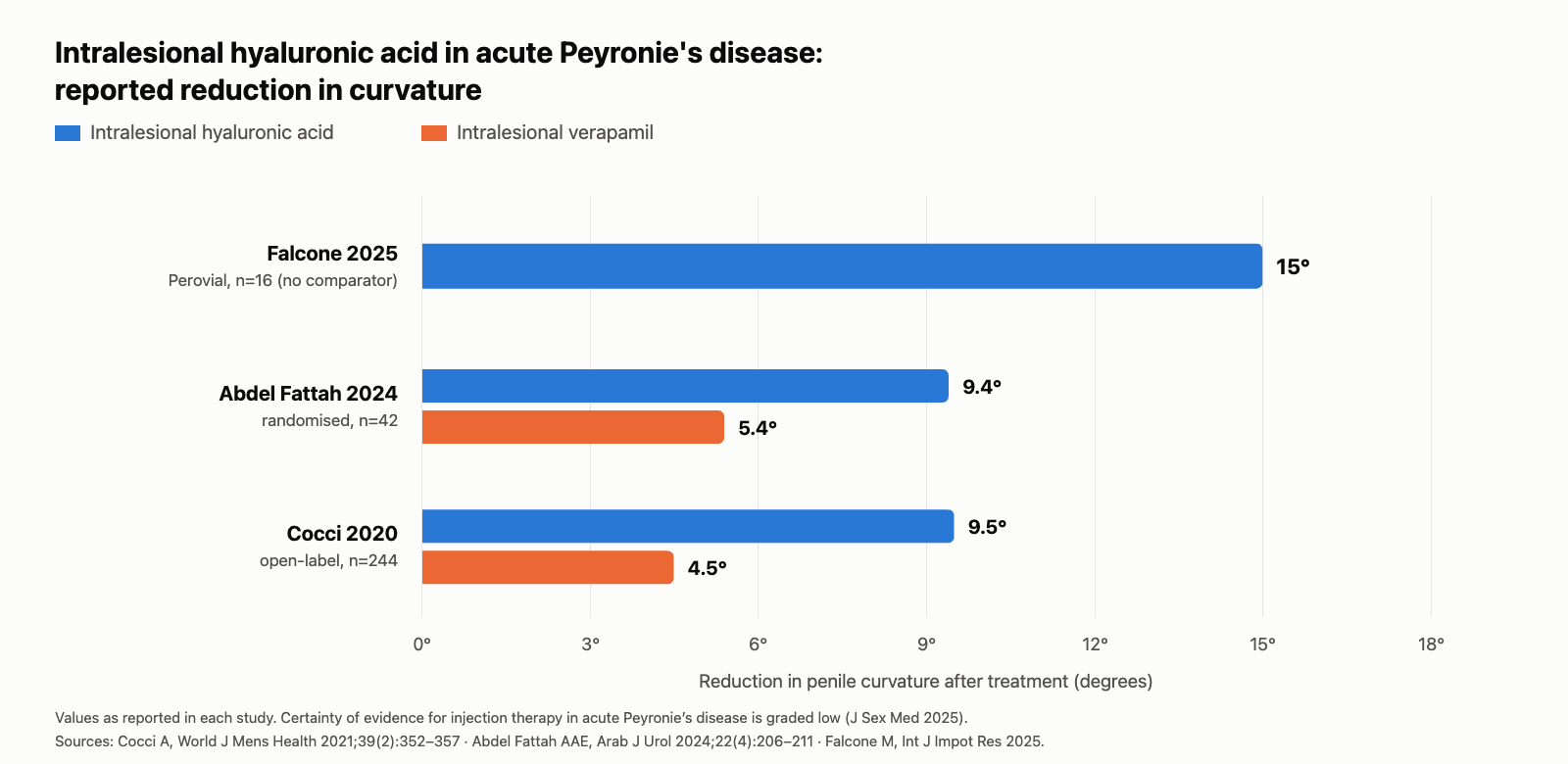
Compared with verapamil, the most common off-label alternative. A prospective open-label study of 244 men in the acute phase compared eight weekly hyaluronic acid injections with eight weekly verapamil injections. Median curvature fell by 9.5° in the hyaluronic acid group against 4.5° with verapamil, and pain scores improved substantially more with hyaluronic acid (The World Journal of Men’s Health, 2021). This study was not randomised, which limits how much weight it can carry.
A randomised trial reached the same direction of effect. Forty-two men were randomised to twelve weekly injections of either hyaluronic acid or verapamil. Curvature fell from 34.1° to 24.7° with hyaluronic acid and from 36.2° to 30.8° with verapamil, and the difference between the groups was statistically significant (Arab Journal of Urology, 2024). Forty-two patients is a small trial, and it should be read as supportive rather than definitive.
Adding oral hyaluronic acid improved results in a phase III trial. Eighty-one men with recently diagnosed disease received six weekly injections either with or without oral hyaluronic acid. The combined group had a larger reduction in curvature (−7.8° against −4.1°) and better erectile function and satisfaction scores (The World Journal of Men’s Health, 2021).
The first published experience with Perovial specifically. Sixteen men in the acute phase, with a median baseline curvature of 43°, were treated with ten weekly sessions combined with daily vacuum therapy and penile modelling. Median curvature reduction was 15°, with significant pain relief and no complications (International Journal of Impotence Research, 2025). Sixteen patients is a preliminary series, and the authors present it as such.
The systematic review is appropriately cautious. A 2025 systematic review of injection therapy in acute Peyronie’s disease covered 20 studies and 1,291 patients, of which only four were randomised controlled trials. It found improvements in curvature and pain of variable magnitude, and adverse events that were mostly mild and local — bruising, swelling, ecchymosis — with no severe complications reported in any study. Its conclusion was that the evidence supports feasibility, while the overall quality remains low with significant methodological limitations (The Journal of Sexual Medicine, 2025).
A fair summary
Intralesional hyaluronic acid appears to reduce curvature and pain in the acute phase more than verapamil does, with a good safety record across more than a thousand treated patients. It has not been shown to straighten a penis completely, it is not a substitute for surgery in a man with a severe stable deformity, and there is not yet a large randomised trial of Perovial itself. A realistic expectation is a modest reduction in curvature, meaningful relief of pain, and a reasonable prospect of limiting progression — not a cure.
Who is Perovial suitable for?
It is most likely to help a man who:
- is in the acute phase — symptoms for less than about 12 to 18 months, with curvature that is still changing;
- has pain on erection, which responds better than curvature does;
- wants to act rather than wait, and understands the aim is to modify the course of the disease rather than to straighten it fully;
- is willing to commit to weekly attendance for 10 to 12 weeks and to the daily vacuum and modelling routine that goes with it.
Perovial is not the right treatment for a man whose disease is stable and whose curvature prevents intercourse. In that situation the honest options are shockwave therapy for pain, corrective surgery, or a penile implant where erectile dysfunction coexists.
Frequently asked questions
Is Perovial available on the NHS?
No. It is a recently launched licensed product and is not currently commissioned by the NHS for routine use, so in practice it is accessed privately.
How is Perovial different from collagenase?
Collagenase digests mature collagen and was studied in the chronic, stable phase. Perovial is hyaluronic acid, used in the acute phase with the aim of influencing plaque formation while it is still active. They are used at different points in the disease, not as direct alternatives.
Does it hurt?
The injection is performed under local anaesthetic and takes a few minutes. Side effects reported across published studies are mild and local: bruising, swelling and ecchymosis at the injection site. No severe complications were reported in the systematic review of 1,291 patients.
How much curvature improvement can I expect?
Published series report median reductions in the region of 9° to 15°. That is a meaningful change for a moderate curve and a limited one for a severe curve. Any clinician who promises full correction from an injection course is going beyond the evidence.
Can it be combined with shockwave therapy?
The published Perovial protocol combines injections with vacuum therapy and penile modelling, not with shockwave. Combining treatments should be a decision made in consultation, based on which symptom is dominant — pain, curvature, or erectile function — and not offered as a package by default.
How soon should I be seen?
Early. Perovial and other treatments aimed at the acute phase only work while the disease is in the acute phase. If your symptoms began within the last year, an assessment is time-sensitive.
Assessment at Holistic Andrology
Deciding whether Perovial is appropriate requires establishing which phase the disease is in. That means a history, examination of the plaque, objective measurement of the curvature, and a penile Doppler ultrasound where erectile function is also affected. The phase — not the patient’s preference or the clinic’s preference — determines the treatment.
Consultation and treatment fees are listed on the prices page.
This article provides general information and does not replace individual medical assessment.
References
- Cocci A, Di Maida F, Cito G, et al. Comparison of intralesional hyaluronic acid vs. verapamil for the treatment of acute phase Peyronie’s disease. World J Mens Health. 2021;39(2):352–357. doi:10.5534/wjmh.190108
- Abdel Fattah AAE, Diab T, El-Dakhakhny AS, El Hamshary SA. Intralesional injection of hyaluronic acid compared with verapamil in acute phase of Peyronie’s disease: a prospective randomized clinical trial. Arab J Urol. 2024;22(4):206–211. doi:10.1080/20905998.2024.2333583
- Cai T, Tiscione D, Favilla V, et al. Oral administration and intralesional injection of hyaluronic acid versus intralesional injection alone in Peyronie’s disease: results from a phase III study. World J Mens Health. 2021;39(3):526–532. doi:10.5534/wjmh.200048
- Falcone M, Cirigliano L, Preto M, Timpano M. Targeting the acute phase of Peyronie’s disease: preliminary experience with Perovial, a novel hyaluronic acid formulation. Int J Impot Res. 2025. doi:10.1038/s41443-025-01223-2
- Manfredi C, Russo GI, Capogrosso P, et al. Injection therapy in the acute phase of Peyronie’s disease: a systematic review of current evidence. J Sex Med. 2025;22(5):799–812. doi:10.1093/jsxmed/qdaf044
Literature retrieved via PubMed.
Prof Fabio Castiglione, MD, PhD, FECSM, FEBU, Urologist (ITA)
Consultant Urologist and Andrologist — King’s College Hospital NHS Foundation Trust
Hon. Reader, King’s College London (UK) — Academic Lead of Urology
GMC 7542824 · Director and Founder of Holistic Andrology
Publications on PubMed · ORCID · Verify GMC registration