
Medically reviewed by Prof Fabio Castiglione, GMC 7542824 — last reviewed 20 August 2026
Male infertility means a reduced ability to father a child, usually identified when a couple has not conceived after twelve months of regular unprotected intercourse. Male factors contribute to an estimated 30–50% of cases of couple infertility (Nature Reviews Disease Primers, 2023). In roughly half of those cases the cause is identifiable and, in a meaningful proportion, treatable.
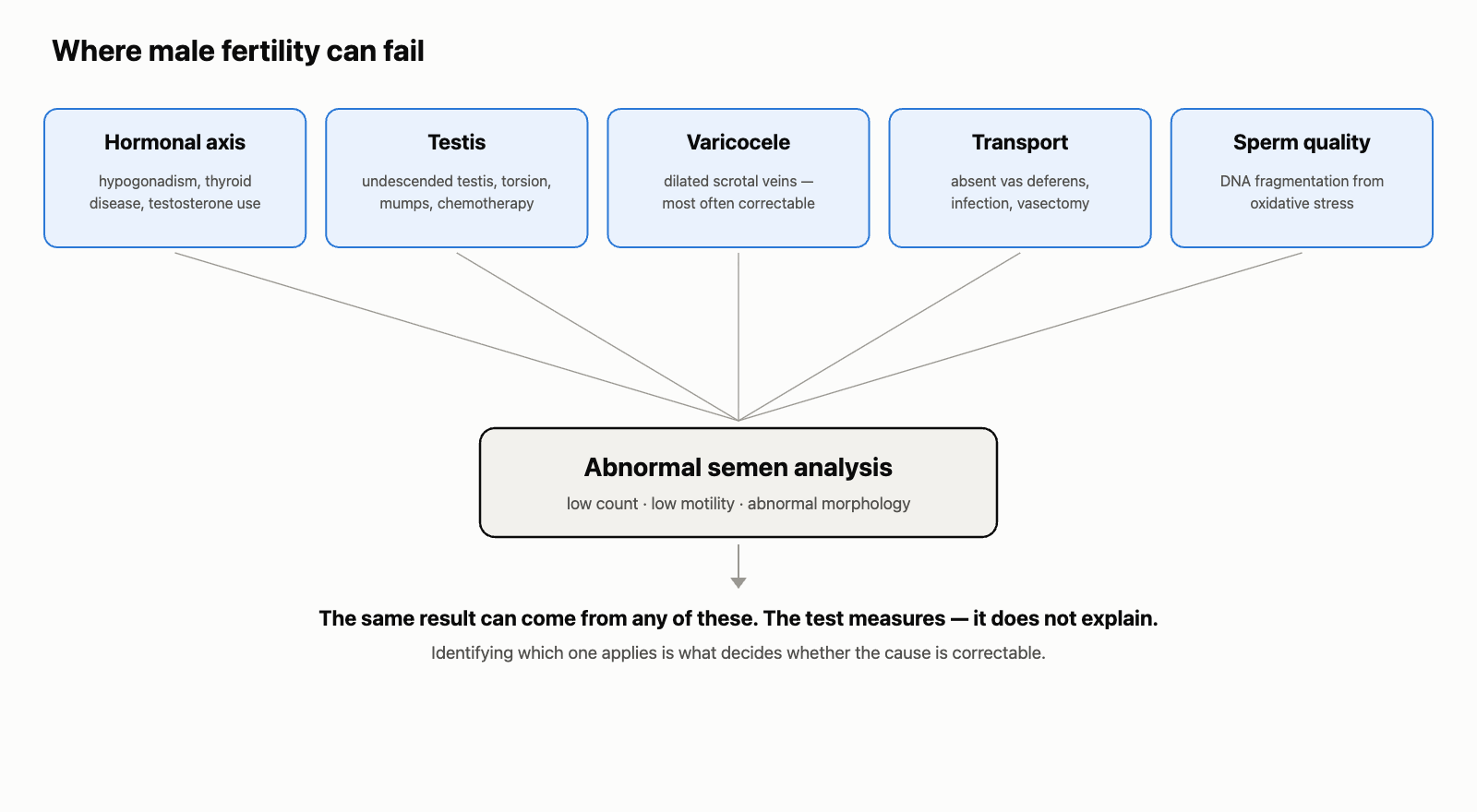
The single most important point in this article is this: a man with a low sperm count deserves a diagnosis, not just a referral to IVF. A semen analysis is a measurement, not an explanation. Two men with identical results can have entirely different causes, entirely different prognoses, and entirely different treatments.
What causes male infertility?
Sperm production is a long process — roughly 72 days from start to finish — that depends on a functioning testis, an intact hormonal axis, an unobstructed pathway out, and the absence of anything that damages the process along the way. A problem at any of those points reduces the count, the motility, the shape, or the DNA quality of the sperm.
- Varicocele — dilated veins around the testis, present in around 15% of men and considerably more often in men with abnormal semen parameters. It is the most common surgically correctable cause.
- Hormonal causes — hypogonadotropic hypogonadism, thyroid disease, hyperprolactinaemia. Some are highly treatable with medication. Importantly, testosterone replacement suppresses sperm production and is the wrong treatment for a man trying to conceive.
- Genetic causes — Klinefelter syndrome and Y-chromosome microdeletions can severely limit spermatogenesis. Genetic testing is guided by the semen analysis findings and also predicts the likelihood of successfully retrieving sperm surgically (Deutsches Ärzteblatt International, 2025).
- Obstruction — congenital absence of the vas deferens, previous infection, or previous surgery including vasectomy. Here the testis works; the pathway does not.
- Testicular causes — undescended testis in childhood, testicular torsion, trauma, infection such as mumps orchitis, and the effects of chemotherapy or radiotherapy.
- Lifestyle and exposure — smoking, obesity, heat exposure, anabolic steroids, and some prescribed medicines. These are frequently modifiable, and their effect is often underestimated.
- Sperm DNA fragmentation — damage to the genetic material inside otherwise normal-looking sperm, driven largely by oxidative stress. It is a recognised cause of poor outcomes in couples whose standard semen analysis appears acceptable (JBRA Assisted Reproduction, 2024).
- Unexplained — in a proportion of men no cause is found despite proper investigation. Saying so is more useful than inventing a diagnosis.
Which tests actually matter in male infertility?
Semen analysis — and why one is never enough
Semen analysis is the starting point of any male infertility assessment, not the conclusion. Results vary considerably between samples from the same man, which is why a single abnormal result should always be repeated before any conclusion is drawn, ideally after an interval of a few weeks. Reference values published by the World Health Organization describe the lower limits found in men whose partners conceived within twelve months — they are not a pass mark, and men below them do conceive naturally.
The parameters that matter are concentration, total count, motility, morphology and volume. A result should be interpreted together with the examination and the hormone profile, not read in isolation.
Physical examination
An examination identifies a varicocele, assesses testicular volume, and detects an absent vas deferens. It takes minutes and it changes management. It is also the step most often skipped when a man is referred straight into a fertility pathway.
Hormone profile
FSH, LH, testosterone and prolactin distinguish a testis that is failing from a testis that is not being stimulated — a distinction that determines whether medical treatment can help.
Scrotal ultrasound
A scrotal ultrasound confirms a varicocele, measures testicular volume objectively, and rules out testicular tumours — which are more common in men presenting with infertility than in the general population.
Genetic testing
Karyotype and Y-chromosome microdeletion testing are indicated in severe oligozoospermia and azoospermia. The result affects not only the treatment plan but the counselling given to the couple about their future children.
Sperm DNA fragmentation testing
Reserved for specific situations: recurrent pregnancy loss, repeated failure of assisted reproduction, or a normal semen analysis with unexplained infertility. It should be requested for a reason, not added routinely.
What treatment for male infertility can realistically achieve
Correcting a reversible cause. Stopping anabolic steroids, treating an endocrine disorder, losing weight, stopping smoking. These are unglamorous and they work more often than they are given credit for. Because spermatogenesis takes about three months, no change should be judged before then.
Varicocele repair. Microsurgical varicocelectomy improves semen parameters in appropriately selected men — those with a clinically palpable varicocele and abnormal semen analysis. It is not indicated for a varicocele found incidentally on ultrasound in a man with normal parameters.
Medical therapy. Hormonal treatment can restore sperm production in hypogonadotropic hypogonadism. It is far less predictable in idiopathic cases, and should be described that way.
Surgical sperm retrieval. In azoospermia, sperm can often be retrieved directly from the testis for use in assisted reproduction. In non-obstructive cases, microsurgical retrieval finds sperm in a substantial proportion of men in whom the semen contains none.
Assisted reproduction. IVF and ICSI remain the route for many couples. They are more effective, and sometimes avoidable, when the male factor has first been diagnosed and optimised rather than bypassed.
Frequently asked questions
How long should we try before seeking help?
Twelve months of regular unprotected intercourse is the conventional threshold for investigating male infertility, and six months if the female partner is over 35 or there is a known risk factor on either side. If you already know of a relevant factor — an undescended testis, previous chemotherapy, a testicular injury — there is no reason to wait.
Can a low sperm count be cured?
Sometimes. It depends entirely on the cause of the male infertility. Obstruction, hormonal deficiency and varicocele are potentially correctable. Primary testicular failure and some genetic causes are not, although sperm may still be retrievable. This is precisely why the diagnosis matters more than the number.
Does testosterone help male fertility?
No — it does the opposite. Exogenous testosterone suppresses the hormonal signal that drives sperm production and can cause azoospermia. Any man on testosterone who wishes to conceive needs a specific discussion before continuing.
Do supplements work?
Antioxidant supplements are widely sold and the evidence for them is weak and inconsistent. They are unlikely to be harmful and they are not a substitute for identifying a cause.
Is infertility linked to general health?
Yes. Men presenting with infertility have a higher incidence of testicular cancer and of undiagnosed endocrine and metabolic disorders than the general population. A fertility assessment is also a health assessment, which is one more reason to have one rather than proceed straight to IVF.
How long do results take to change?
About three months, because that is the length of one cycle of sperm production. Repeating a semen analysis sooner than that measures noise rather than progress.
Assessment at Holistic Andrology
A male infertility assessment at 9 Harley Street includes a full history, physical examination, review or arrangement of semen analysis, hormone profile, and scrotal ultrasound where indicated. The aim is a diagnosis — an explanation of why the numbers are what they are and what can be done about it — rather than a repetition of the numbers themselves.
See the Male Fertility Clinic for how the service is run, and the prices page for fees.
This article provides general information and does not replace individual medical assessment.
References
- Eisenberg ML, Esteves SC, Lamb DJ, et al. Male infertility. Nat Rev Dis Primers. 2023;9(1):49. doi:10.1038/s41572-023-00459-w
- Tüttelmann F, Wyrwoll MJ, Steingröver J, Wieacker P. The genetics of female and male infertility. Dtsch Arztebl Int. 2025;122(5):115–120. doi:10.3238/arztebl.m2024.0259
- Andrabi SW, Ara A, Saharan A, et al. Sperm DNA fragmentation: causes, evaluation and management in male infertility. JBRA Assist Reprod. 2024;28(2):306–319. doi:10.5935/1518-0557.20230076
Literature retrieved via PubMed.
Prof Fabio Castiglione, MD, PhD, FECSM, FEBU, Urologist (ITA)
Consultant Urologist and Andrologist — King’s College Hospital NHS Foundation Trust
Hon. Reader, King’s College London (UK) — Academic Lead of Urology
GMC 7542824 · Director and Founder of Holistic Andrology
Publications on PubMed · ORCID · Verify GMC registration