
Medically reviewed by Prof Fabio Castiglione, GMC 7542824 — last reviewed 27 November 2026
Shockwave therapy for chronic prostatitis is a non-invasive treatment in which low-intensity acoustic waves are delivered to the pelvic floor through the perineum, the skin between the scrotum and the anus. It is used for chronic prostatitis/chronic pelvic pain syndrome (CP/CPPS), the non-bacterial form of prostatitis. Randomised sham-controlled trials show that it reduces pain and improves quality of life in the short to medium term. The evidence for long-lasting benefit, and for any effect on urinary or erectile symptoms, is weaker.
This article explains what the treatment involves, what the trials actually measured, and how to decide whether it is worth trying. If you are new to the condition itself, start with our guide to chronic pelvic pain in men.
What is shockwave therapy for chronic prostatitis?
The term “chronic prostatitis” is confusing, because in most men there is no infection. Under the US National Institutes of Health classification, chronic pelvic pain syndrome is category III prostatitis: pelvic pain or discomfort for at least three months, without a bacterial cause that can be demonstrated. It is far more common than bacterial prostatitis, and it rarely responds to antibiotics.
Low-intensity extracorporeal shockwave therapy (Li-ESWT) uses a hand-held applicator placed against the perineum. The energy used is a small fraction of that used to break kidney stones. Treatment does not require anaesthesia, needles or recovery time. A typical protocol involves four to six weekly sessions of about 15–20 minutes, although protocols vary between studies and devices.
How might shockwaves reduce pelvic pain?
The mechanism is not fully established. The proposed effects include:
- Reduced muscle tension in an overactive pelvic floor, which is a common driver of pain in CP/CPPS.
- Modulation of pain signalling — shockwaves appear to interfere with the transmission of pain impulses and may reduce local nerve sensitisation.
- Improved local blood flow and a reduction in local inflammation, suggested by laboratory and animal studies.
These are hypotheses rather than proven facts. What matters to patients is whether the treatment works better than a convincing placebo, and that has been tested directly.
What does the evidence say?
The first double-blind, placebo-controlled trial was published in European Urology in 2009. Sixty men with CP/CPPS received four weekly sessions of perineal shockwave therapy or an identical sham procedure with no energy delivered. Pain, quality of life and voiding symptoms improved significantly in the treated group compared with placebo, and no side effects were reported (Zimmermann et al., 2009).
Since then, several meta-analyses have pooled the randomised trials:
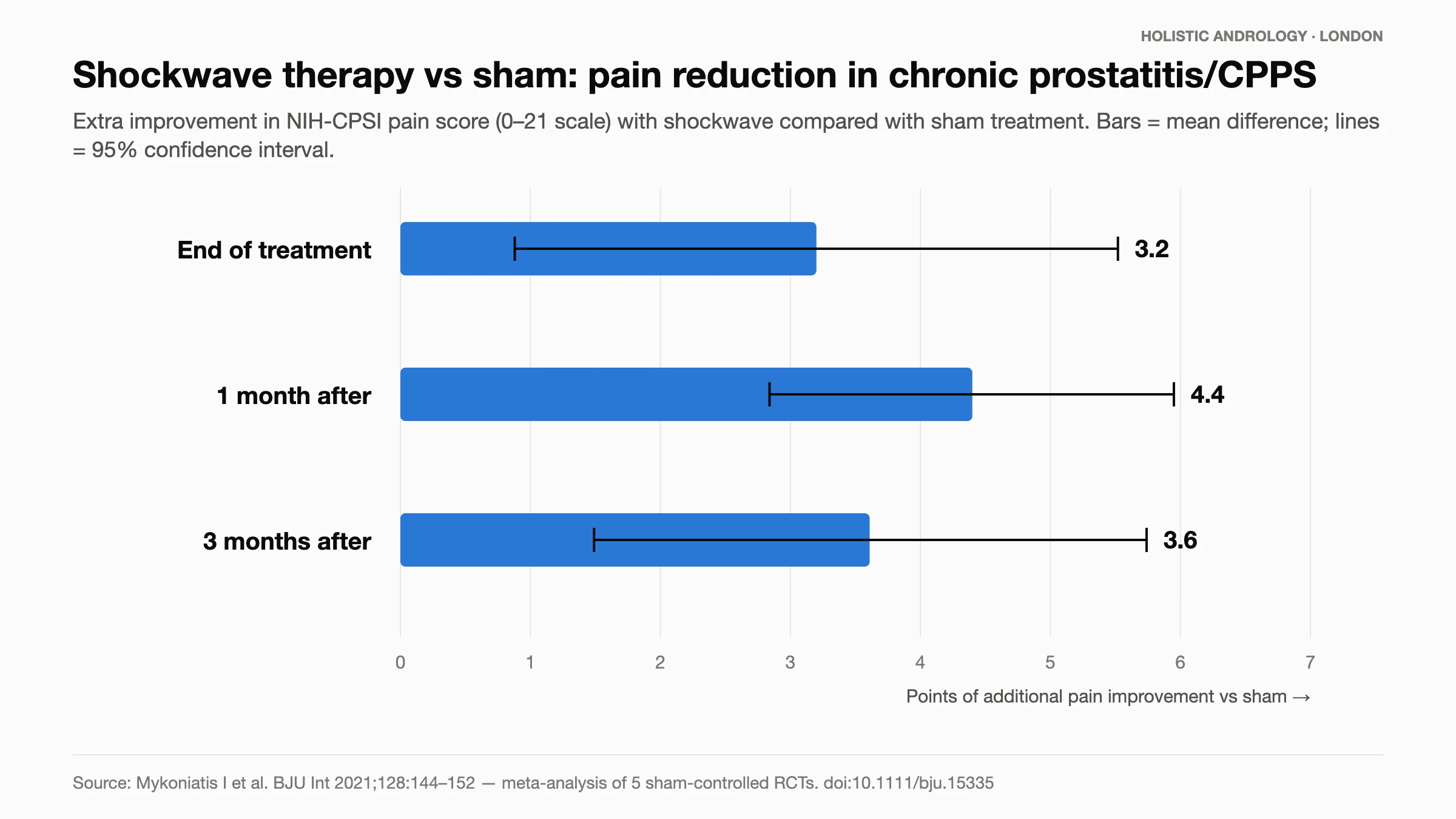
- A 2021 meta-analysis in BJU International pooled five sham-controlled trials. Shockwave therapy improved the NIH Chronic Prostatitis Symptom Index (NIH-CPSI) pain score compared with sham immediately after treatment, at one month and at three months. However, the authors judged the long-term effect, and the effect on urinary symptoms and erectile function, to be clinically insignificant (Mykoniatis et al., 2021).
- A 2023 meta-analysis of 12 randomised trials (651 patients) found lower NIH-CPSI total, pain and quality-of-life scores up to 24 weeks after treatment, with larger and longer-lasting reductions when shockwave therapy was combined with medication (Kong et al., 2023).
- A 2024 meta-analysis reported that pain relief was still present at six-month follow-up (Labetov et al., 2024).
- A 2026 meta-analysis of nine trials in men with both CP/CPPS and erectile dysfunction found improvements in both, but rated the certainty of evidence as low for every efficacy outcome and high for safety (Liu et al., 2026).
How to read these results honestly
The pain improvement is real and consistent across trials. But three caveats matter:
- Trials are small and protocols differ, so the size of the effect is uncertain.
- Follow-up is short. Most trials stop at three to six months. We do not know how many men stay well at one or two years.
- Pain improves more than urinary or sexual symptoms. If your main problem is frequency, urgency or erections, shockwave therapy alone is unlikely to be enough.
In other words, shockwave therapy is a reasonable, low-risk option for the pain component of CP/CPPS. It is not a cure, and anyone promising one is going beyond the evidence.
Who is most likely to benefit?
CP/CPPS is not one disease. Specialists often describe it using the UPOINT system, which sorts symptoms into urinary, psychosocial, organ-specific, infection, neurological and muscle-tenderness domains (Snow and Shoskes, 2010). Shockwave therapy makes most sense when pain and pelvic floor muscle tenderness dominate.
It is generally a poor fit if:
- you have a proven bacterial infection, which needs targeted antibiotics;
- your main symptoms are urinary and caused by obstruction or an enlarged prostate;
- significant anxiety or depression is maintaining the pain and has not been addressed.
This is why the first step is an assessment, not a course of treatment.
What does treatment involve?
At our male pelvic pain clinic we first confirm the diagnosis. This usually involves a symptom score (NIH-CPSI), urine tests to exclude infection, an examination including the pelvic floor, and a urine flow test where urinary symptoms are present.
If shockwave therapy is appropriate, sessions are performed in the clinic with you lying on your back. You may feel a tapping sensation, which most men describe as mildly uncomfortable at most. You can return to normal activities immediately. Response is reassessed with the same symptom score at the end of the course and at follow-up, so the decision to continue is based on measurement rather than impression. More detail is on our shockwave for CPPS page.
Is it safe?
Across the trials, low-intensity shockwave therapy has been well tolerated. Reported side effects are uncommon and minor, such as temporary discomfort or bruising. One trial reported a few cases of transient blood in the urine or semen (Liu et al., 2026). It should not be used over areas of active infection, in men with untreated bleeding disorders, or where cancer has not been excluded.
How does it compare with other treatments?
Most men with CP/CPPS do best with more than one approach. Shockwave therapy is commonly combined with:
- pelvic floor physiotherapy focused on relaxation, not strengthening;
- alpha-blockers when urinary symptoms are prominent;
- pain-modulating medication where nerve sensitisation is suspected;
- psychological support for the stress–pain cycle.
The 2023 meta-analysis found that combining shockwave therapy with medication produced larger and more durable improvements than shockwave alone (Kong et al., 2023).
Frequently asked questions
How many sessions of shockwave therapy do I need for chronic prostatitis?
Most trial protocols used four to six weekly sessions. The right number depends on your response, which should be measured with a validated symptom score.
Is shockwave therapy for chronic prostatitis painful?
It is usually well tolerated without anaesthesia. Most men feel a tapping sensation in the perineum. The intensity can be adjusted.
Will shockwave therapy cure chronic prostatitis?
No treatment reliably cures CP/CPPS. Shockwave therapy reduces pain for many men, and trials show benefit lasting at least three to six months, but long-term data are limited.
Does it help erectile dysfunction caused by pelvic pain?
Some trials suggest improvement in erectile function in men with both conditions, but the certainty of this evidence is low. Erectile problems should be assessed separately.
Is shockwave therapy available on the NHS?
Shockwave therapy for CP/CPPS is not routinely available on the NHS. It is offered in some private specialist clinics.
This article provides general information and does not replace individual medical assessment. If you have persistent pelvic pain, fever, difficulty passing urine or blood in your urine, see a doctor promptly.
References
- Krieger JN, Nyberg L, Nickel JC. NIH consensus definition and classification of prostatitis. JAMA. 1999;282(3):236–237. doi:10.1001/jama.282.3.236
- Zimmermann R, Cumpanas A, Miclea F, Janetschek G. Extracorporeal shock wave therapy for the treatment of chronic pelvic pain syndrome in males: a randomised, double-blind, placebo-controlled study. Eur Urol. 2009;56(3):418–424. doi:10.1016/j.eururo.2009.03.043
- Mykoniatis I, Pyrgidis N, Sokolakis I, et al. Low-intensity shockwave therapy for the management of chronic prostatitis/chronic pelvic pain syndrome: a systematic review and meta-analysis. BJU Int. 2021;128(2):144–152. doi:10.1111/bju.15335
- Kong X, Hu W, Dong Z, et al. The efficacy and safety of low-intensity extracorporeal shock wave treatment combined with or without medications in chronic prostatitis/chronic pelvic pain syndrome: a systematic review and meta-analysis. Prostate Cancer Prostatic Dis. 2023;26(3):483–494. doi:10.1038/s41391-022-00571-0
- Labetov I, Vaganova A, Kovalev G, Shkarupa D. Extracorporeal shockwave therapy in treatment of chronic prostatitis/chronic pelvic pain syndrome: systematic review and meta-analyses. Neurourol Urodyn. 2024;43(8):1924–1937. doi:10.1002/nau.25524
- Liu X, Ren L, Huang W, Zhang J. Extracorporeal shock wave therapy in patients with chronic prostatitis/chronic pelvic pain syndrome and erectile dysfunction: a systematic review and meta-analysis. Sex Med Rev. 2026;14(2). doi:10.1093/sxmrev/qeag037
- Snow DC, Shoskes DA. Pharmacotherapy of prostatitis. Expert Opin Pharmacother. 2010;11(14):2319–2330. doi:10.1517/14656566.2010.495946
Literature retrieved via PubMed.

Prof Fabio Castiglione, MD, PhD, FECSM, FEBU, Urologist (ITA)
Consultant Urologist and Andrologist — King’s College Hospital NHS Foundation Trust
Hon. Reader, King’s College London (UK) — Academic Lead of Urology
GMC 7542824 · Director and Founder of Holistic Andrology
Prof Castiglione has published extensively in peer-reviewed journals on andrology and regenerative urology. Publications on PubMed · ORCID · Verify GMC registration