

Medically reviewed by Prof Fabio Castiglione, GMC 7542824 — last reviewed 27 November 2026
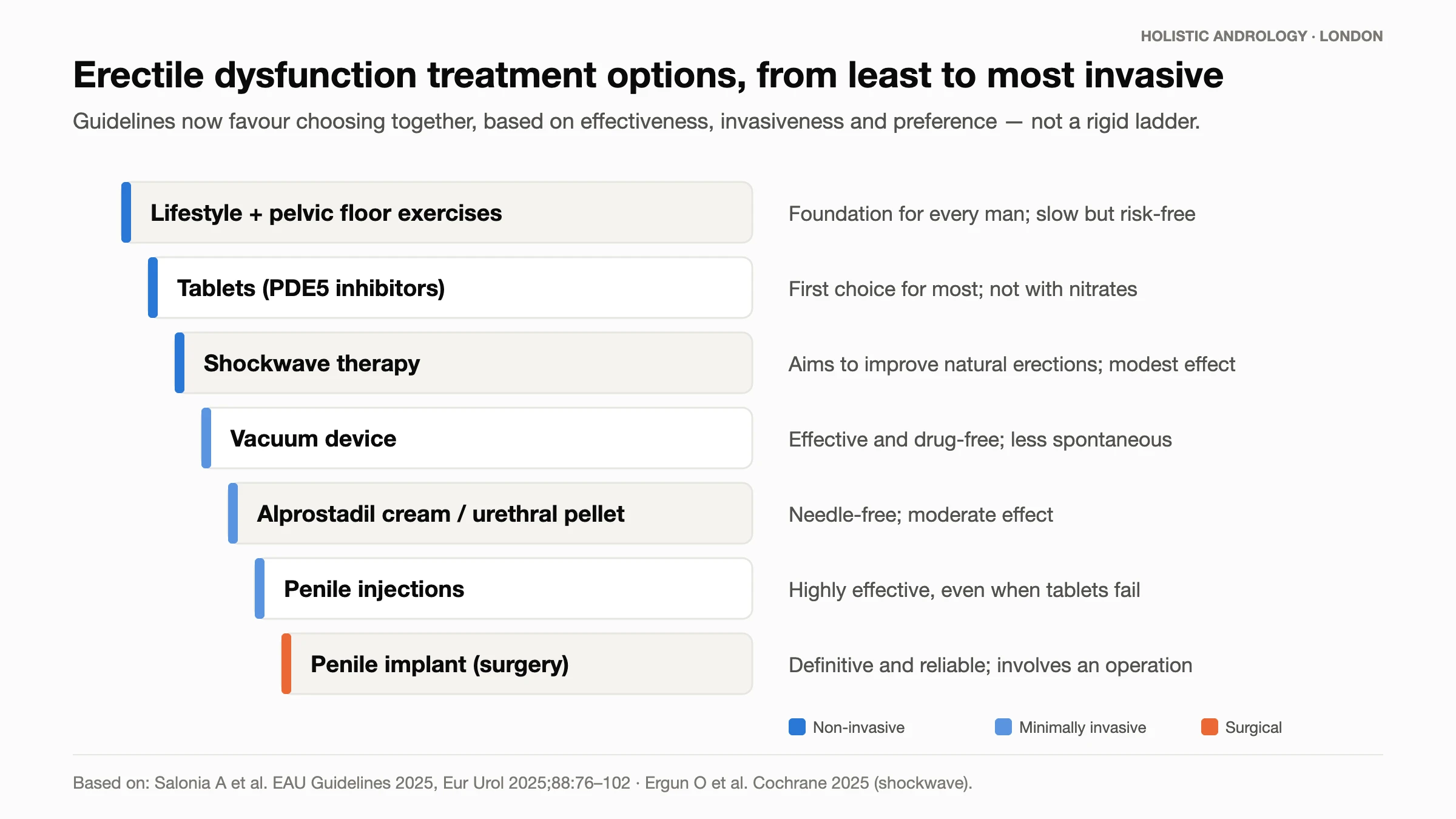
Erectile dysfunction treatment options range from lifestyle changes and tablets to injections, vacuum devices, shockwave therapy and penile implant surgery. Tablets called PDE5 inhibitors (such as sildenafil and tadalafil) are the usual first choice and work for most men. When they fail or are unsuitable, injections, devices and surgery offer reliable alternatives. Newer regenerative treatments such as shockwave therapy have a smaller and less certain effect. The right choice depends on the cause, your health and what you want from treatment.
European Association of Urology (EAU) guidelines now favour a shared decision based on each treatment’s effectiveness, invasiveness and side effects, rather than a rigid step-by-step ladder (Salonia et al., 2025). This guide compares the options side by side.
Why does the cause matter before choosing a treatment?
Erectile dysfunction is a symptom, not a diagnosis. It can reflect reduced blood flow, nerve damage, hormone problems, medication side effects, psychological factors, or several of these together. It can also be an early warning sign of heart disease or diabetes.
A proper assessment — history, examination, blood tests including glucose, lipids and testosterone where indicated — sometimes reveals a treatable cause. Our guide to the causes of erectile dysfunction explains this in detail.
Lifestyle changes: do they really help?
Yes. Stopping smoking, losing weight, regular aerobic exercise and good control of blood pressure, diabetes and cholesterol improve erectile function and overall health. They also make every other treatment work better. Pelvic floor exercises are another low-risk option: in one randomised trial, 40% of men regained normal erectile function after six months of supervised training (Dorey et al., 2005).
How well do ED tablets work?
PDE5 inhibitors increase blood flow into the penis in response to sexual stimulation. They do not cause an erection on their own. The main options in the UK are sildenafil, tadalafil, vardenafil and avanafil.
A network meta-analysis of 82 trials involving more than 47,000 men compared them directly. At standard starting doses, sildenafil 50 mg was the most effective but had the most side effects. Tadalafil 10 mg was intermediate in effectiveness but best tolerated (Chen et al., 2015). Tadalafil also lasts up to 36 hours and can be taken daily at a low dose, which suits some couples better.
Common side effects include headache, flushing, nasal congestion and indigestion. PDE5 inhibitors must never be combined with nitrate medicines such as GTN spray, because the combination can cause a dangerous fall in blood pressure.
If tablets “don’t work”, the reason is often how they are taken: too soon before sex, after a heavy meal (for sildenafil), without sexual stimulation, or only tried once or twice. A review of technique and dose fixes many apparent failures.
What can be done if tablets do not work?
Vacuum erection devices
A cylinder placed over the penis creates negative pressure that draws blood in; a ring at the base maintains the erection. They work for most men, are drug-free and inexpensive, but some find them awkward and the erection can feel cool.
Alprostadil cream or urethral pellets
Alprostadil is applied to the tip of the penis or inserted into the urethra. It avoids needles but is less effective than injections.
Penile injections
Injecting alprostadil (or a combination of medicines) into the side of the penis produces an erection within minutes, independent of nerve signals. This makes injections effective even where tablets fail, including after prostate surgery. The main risks are pain and, rarely, a prolonged erection (priapism) that needs urgent treatment, so the first dose is given in the clinic.
What about shockwave therapy for ED?
Low-intensity shockwave therapy aims to improve blood flow in men with vascular erectile dysfunction. It is the only option that aims to improve natural erections rather than create them on demand.
The most rigorous summary is a 2025 Cochrane review of 21 randomised trials (1,357 men). Compared with sham treatment, shockwave therapy improved the erectile function score by about 3.9 points in the short term — just below the 4-point threshold usually considered noticeable to patients — and by about 5.3 points beyond three months. The certainty of the evidence was low, several trials were funded by device makers, and side effects were no more common than with sham (Ergun et al., 2025).
In practice, it is most reasonable for men with mild to moderate vascular ED who want to reduce reliance on tablets, with honest expectations. Read more on our shockwave for erectile dysfunction page.
Are PRP and Botox injections for ED proven?
Platelet-rich plasma (PRP) and botulinum toxin injections are being studied as regenerative or blood-flow-improving treatments. Early results are interesting, but the evidence is still limited, and European guidelines do not yet recommend them for routine use. If you consider them, they should be offered with clear information about what is and is not known, ideally with outcomes measured.
When is a penile implant the right choice?
A penile prosthesis is a device placed inside the penis during surgery, usually an inflatable three-piece implant controlled by a small pump in the scrotum. It provides a reliable, on-demand erection regardless of the cause. EAU guidelines recommend it for men who do not respond to, or do not want, less invasive treatments (Salonia et al., 2025). Satisfaction among men and partners is high in published series. The trade-offs are those of any operation, including infection and mechanical failure, and it permanently changes the erectile tissue. See our penile prosthesis page.
Where does psychological therapy fit?
Psychological factors play a part in many men’s erectile problems, even when there is also a physical cause. A Cochrane review found that group psychotherapy improved erectile function, and that combining it with sildenafil worked better than sildenafil alone and reduced the number of men stopping treatment (Melnik et al., 2007). Psychosexual therapy is particularly useful for younger men and where anxiety or relationship issues are prominent.
How do the treatments compare at a glance?
- Lifestyle and pelvic floor exercises: no risk, slow, best as a foundation.
- Tablets: effective for most, taken before sex or daily; not with nitrates.
- Vacuum device: effective, drug-free, less spontaneous.
- Urethral or topical alprostadil: needle-free, moderate effect.
- Injections: highly effective, including when tablets fail; small risk of priapism.
- Shockwave therapy: non-invasive, aims to improve natural erections, modest effect.
- Penile implant: definitive and reliable, involves surgery.
After prostate cancer treatment the approach is different; see our page on erectile dysfunction after prostate cancer.
Frequently asked questions
What is the most effective treatment for erectile dysfunction?
For on-demand erections, injections and penile implants are the most reliable. For most men, tablets are effective enough to be the first choice. The “best” treatment is the one that suits your cause, health and preferences.
Is there a permanent cure for erectile dysfunction?
Sometimes — when a reversible cause, such as a medication side effect, low testosterone or anxiety, is identified and treated. For ED caused by established blood vessel or nerve damage, treatments control the problem rather than cure it.
Can I buy ED tablets without seeing a doctor?
Sildenafil is available from UK pharmacies after a pharmacist consultation. It is still worth seeing a doctor, because erectile dysfunction can be the first sign of heart disease or diabetes.
Does shockwave therapy replace tablets?
For some men with mild vascular ED it reduces the need for tablets. For many, it is used alongside them.
This article provides general information and does not replace individual medical assessment. Do not start or combine erectile dysfunction medicines without checking with a doctor or pharmacist.
References
- Salonia A, Capogrosso P, Boeri L, et al. European Association of Urology guidelines on male sexual and reproductive health: 2025 update on male hypogonadism, erectile dysfunction, premature ejaculation, and Peyronie’s disease. Eur Urol. 2025;88(1):76–102. doi:10.1016/j.eururo.2025.04.010
- Chen L, Staubli SE, Schneider MP, et al. Phosphodiesterase 5 inhibitors for the treatment of erectile dysfunction: a trade-off network meta-analysis. Eur Urol. 2015;68(4):674–680. doi:10.1016/j.eururo.2015.03.031
- Ergun O, Kim K, Kim MH, et al. Low-intensity shockwave therapy for erectile dysfunction. Cochrane Database Syst Rev. 2025;7(7):CD013166. doi:10.1002/14651858.CD013166.pub3
- Melnik T, Soares BG, Nasselo AG. Psychosocial interventions for erectile dysfunction. Cochrane Database Syst Rev. 2007;(3):CD004825. doi:10.1002/14651858.CD004825.pub2
- Dorey G, Speakman MJ, Feneley RC, Swinkels A, Dunn CD. Pelvic floor exercises for erectile dysfunction. BJU Int. 2005;96(4):595–597. doi:10.1111/j.1464-410X.2005.05690.x
Literature retrieved via PubMed.

Prof Fabio Castiglione, MD, PhD, FECSM, FEBU, Urologist (ITA)
Consultant Urologist and Andrologist — King’s College Hospital NHS Foundation Trust
Hon. Reader, King’s College London (UK) — Academic Lead of Urology
GMC 7542824 · Director and Founder of Holistic Andrology
Prof Castiglione has published extensively in peer-reviewed journals on andrology and regenerative urology. Publications on PubMed · ORCID · Verify GMC registration